Personalized HRV Biofeedback

Find Your
Resonance Frequency

The one breathing rate where your heart, blood pressure, and nervous system move as one. Everyone has one. Most people have never found theirs.

See How It Works

What Is Resonance Frequency?

Your cardiovascular system has a natural rhythm — roughly one cycle every ten seconds. When you breathe at a rate that matches this rhythm (typically 4.5–6.5 breaths per minute), something powerful happens: your breath, heart rate, and blood pressure all begin to oscillate together.

This is resonance — the same physics that lets small, well-timed pushes build a big swing. At your personal resonance frequency, heart rate variability peaks, baroreflex sensitivity increases, and the autonomic nervous system reaches its highest coordination.

The key word is personal. Six breaths per minute is the average, not a prescription. Your resonance frequency depends on your own cardiovascular anatomy and timing. Finding it requires measurement, not guesswork.

Read the full science guide →
4.5–6.5
breaths per minute
The typical resonance range — yours is somewhere in here

How We Find Your Frequency

I use the HeartMath Inner Balance sensor — a clinical-grade ear-clip that reads your heart rhythm beat by beat — paired with custom HRV analysis to pinpoint your exact resonance frequency in a single session.

01

Baseline Reading

We start with a resting HRV measurement to see where your nervous system is right now — your starting coherence, variability, and heart rate.

02

Guided Rate Sweeps

You breathe at several paced rates between 4.5 and 6.5 breaths per minute while the sensor captures your heart rhythm in real time. We're looking for the rate that produces the largest, smoothest heart-rate swings.

03

Analysis & Refinement

I analyze your HRV metrics across each rate — coherence scores, RMSSD, SDNN, frequency-domain power — to confirm where your cardiovascular system responds most strongly. We fine-tune until we've locked in your frequency.

04

Your Personal Protocol

You leave with your exact resonance rate, a custom breathing pacer set to your frequency, and a practice protocol so you can train at resonance on your own — building baroreflex sensitivity and autonomic resilience over time.

What a Session Reveals

This is a real session report from a resonance frequency assessment. Every metric you see here tells part of the story:

  • 85% time in high coherence — the cardiovascular system locked into resonance for nearly the entire session
  • Peak coherence of 8.50 — a strong moment of heart-brain synchronization
  • RMSSD of 46.9 ms — beat-to-beat variability showing healthy parasympathetic tone
  • SDNN of 156.6 ms — overall HRV reflecting strong autonomic adaptability
  • IBI range of 524–1242 ms — wide swings between beats, the hallmark of resonance

These aren't abstract numbers. They're a window into how your autonomic nervous system is performing — and how much room there is to grow.
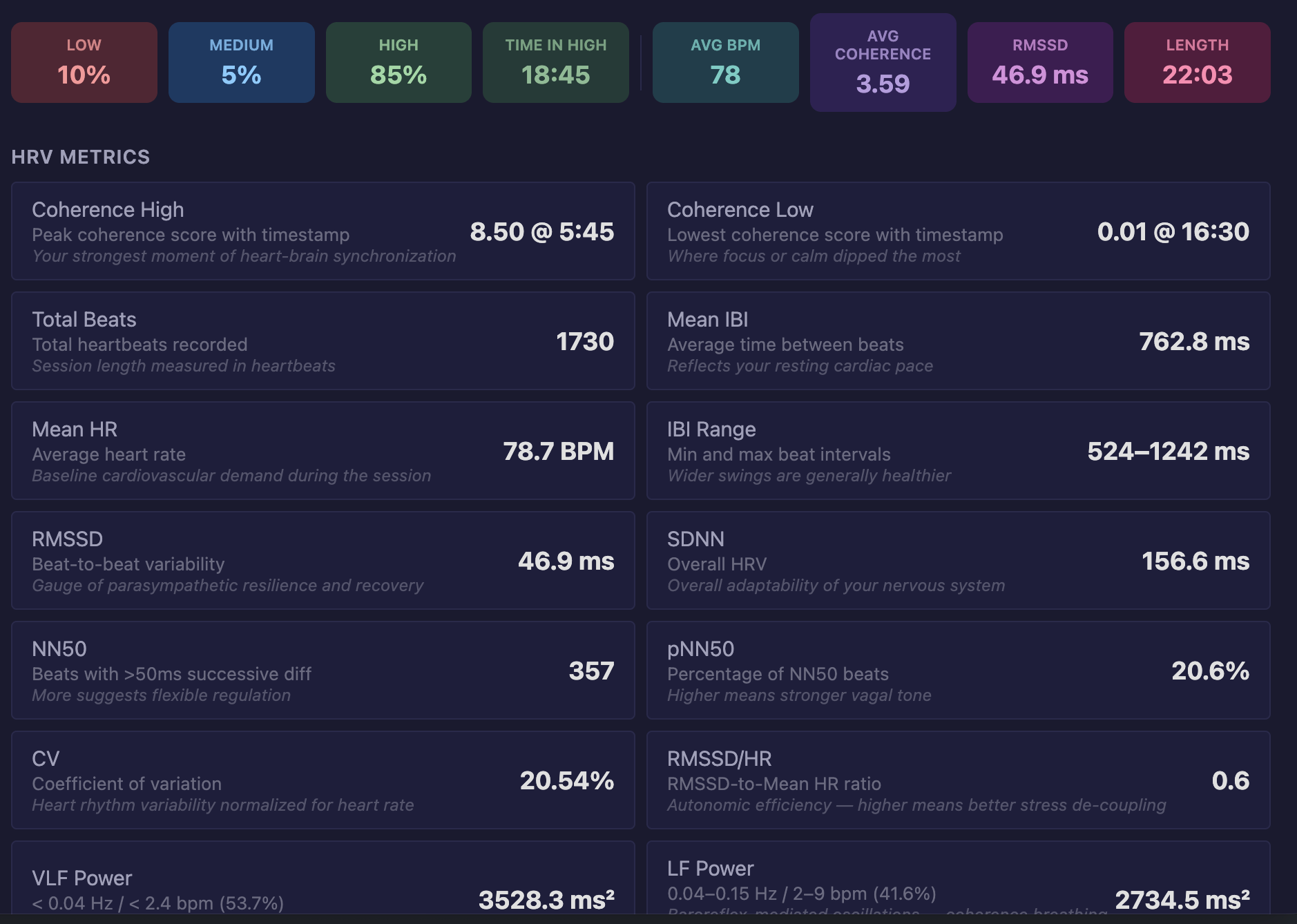
HRV biofeedback session metrics showing coherence scores, heart rate variability, and autonomic nervous system data from a resonance frequency assessment

Your Resonance, Defined

Your Exact Rate

Your personal resonance frequency, determined empirically — not estimated, not averaged, measured from your own heart rhythm data.

Full HRV Report

A detailed breakdown of your session data — coherence, variability, frequency-domain analysis, and what each metric means for you specifically.

Custom Breathing Pacer

A pacer tuned to your personal frequency — inhale and exhale times calibrated so you can train at resonance every day without guessing.

Daily Practice Protocol

A structured plan for building your practice — how long, how often, and what to notice as your baroreflex sensitivity and autonomic resilience improve over weeks.

Who Benefits Most

Resonance frequency training has strong research support across a range of goals. You don't need a diagnosis — just a desire to understand and improve how your nervous system works.

Stress & Anxiety

Meta-analyses show a large effect size (g ≈ 0.83) for anxiety reduction with HRV biofeedback. Resonance breathing gives the nervous system a concrete, daily reset.

Athletic Performance

Higher HRV and baroreflex sensitivity mean faster recovery, better autonomic flexibility, and improved readiness. Many elite athletes use HRV-guided training.

Sleep Quality

Training the parasympathetic nervous system through resonance breathing helps shift the body out of fight-or-flight and into the state it needs for deep, restorative sleep.

Heart & Blood Pressure

Research shows 6/min breathing acutely lowered blood pressure and nearly doubled baroreflex sensitivity in people with hypertension. The effect is rate-specific.

Ready to Find Your Frequency?

A single session is all it takes to discover the breathing rate where your body works best. Book a resonance frequency assessment and start training with precision.